
Hartford Mold Remediation
Local summer humidity reaching 85% accelerates mold spore germination within 24 to 48 hours, producing visible colonies inside wall cavities by hour 72. Our containment teams isolate affected areas immediately to protect indoor air quality. We identify the hidden moisture source and remove active growth safely.
Call (860) 555-0149 with questions.
Prefer to talk? (860) 555-0149
Restoring Clean Air And Sound Structures
Our crews bring extensive field experience evaluating historic stone foundations and multi-family framing across the Connecticut River valley.
A pattern echoed in public discussions is that persistent basement dampness leads to spreading mold growth requiring professional containment barriers and antimicrobial treatment protocols.
Homeowners often describe how tearing out waterlogged drywall after basement flooding exposes hidden mold colonization spreading across wooden studs and base plates.
When unaddressed plumbing leaks compromise structural framing, our team delivers comprehensive emergency water damage restoration across local properties before fungal growth can establish deeper roots.
Every assessment begins with precision infrared imaging and calibrated moisture meters to isolate hidden dampness behind plaster and subflooring.
We work systematically through every affected room to ensure living quarters remain clean, safe, and completely isolated throughout remediation.
Our Four-Stage Containment And Removal Process
Effective remediation requires prompt structural drying following major water intrusion, particularly when extracting standing water and drying finished basements. Category 3 floodwater and sewage cannot be dried in place; porous materials like drywall and carpet require complete removal and antimicrobial treatment.
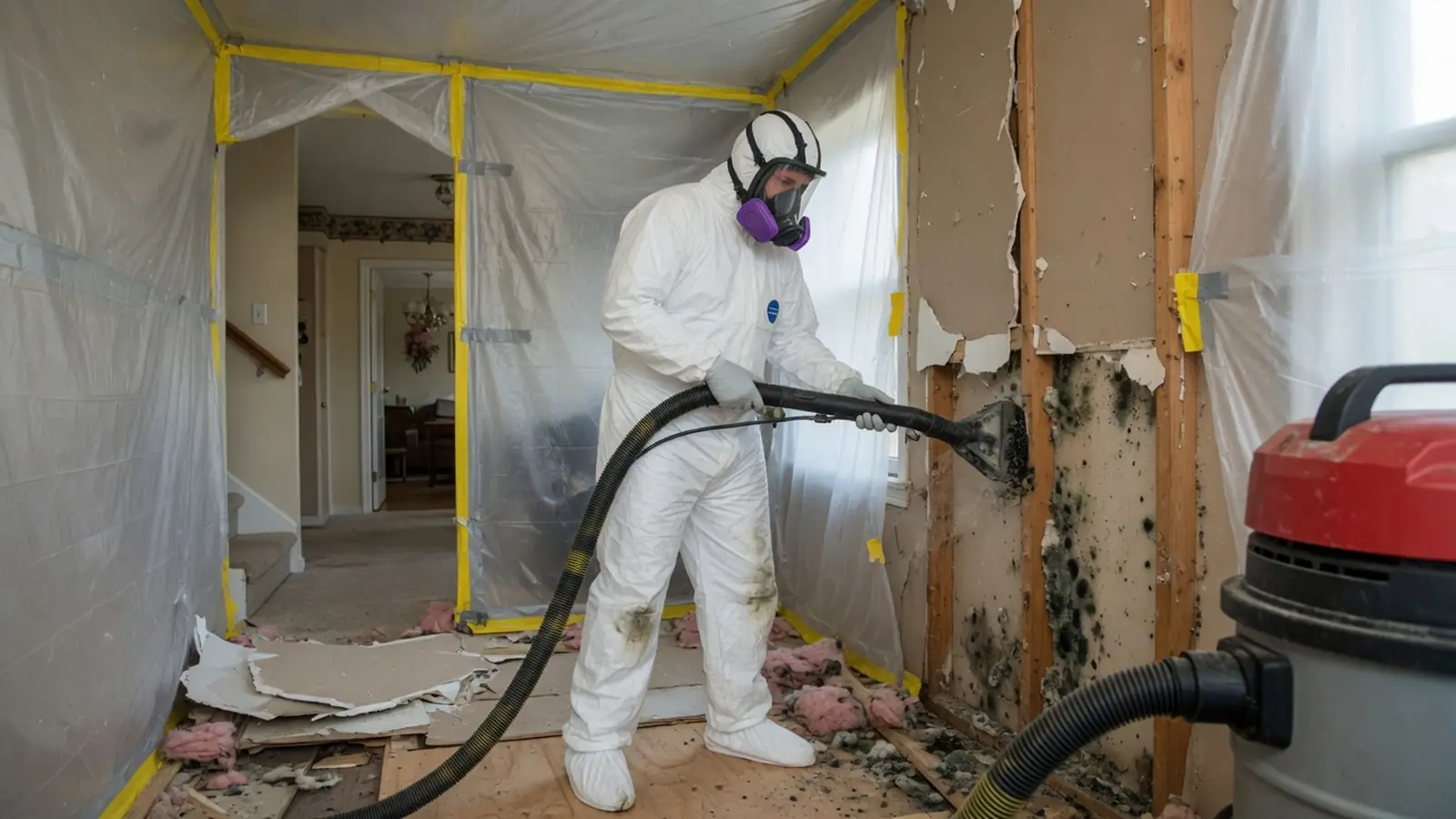
- Containment And Air Scrubbing. Remediation crews erect physical poly containment barriers with negative air HEPA filtration to prevent airborne fungal spores from migrating into clean living areas. Technicians establish continuous negative pressure so cross-contamination cannot reach unaffected rooms.
- Porous Material Removal. Porous materials like water-damaged drywall and carpet padding must be removed and discarded, whereas structural wood framing can usually be sanitized and dried in place. Controlled demolition minimizes dust and ensures all hidden moisture pockets are fully uncovered.
- Antimicrobial Treatment And Scrubbing. Our technicians apply EPA-registered antimicrobial solutions to all exposed framing, followed by HEPA vacuuming and wire brushing to eliminate root hyphae. This deep sanitization prevents dormant spores from reactivating when ambient humidity rises.
- Moisture Verification And Clearance. IICRC standards require objective probe verification showing wood framing below 15% moisture and drywall below 1% before structural rebuild begins. We document structural dryness with calibrated pin meters to certify the structure is ready for reconstruction.
Scientific Standards And Lasting Air Quality
Our team adheres strictly to industry standard protocols, whether remediating long-term crawlspace condensation or mitigating moisture from winter frozen pipes. We never use cosmetic sealants to cover up active mold colonies without physical removal. Every remediation project follows rigorous containment protocols and objective moisture verification before any containment barrier is taken down.
Attic And Roof Leak Remediation
Condensation and roof leaks can rapidly colonize attic sheathing and rafters. We seal the attic hatch, run negative air HEPA scrubbers, and clean structural roof trusses down to bare wood.
Basement And Crawlspace Decontamination
Subgrade masonry walls often trap moisture against interior framing. Our specialists remove contaminated wallboard, disinfect foundation sill plates, and install air movement equipment to halt spread.
HVAC And Air Duct Sanitization
Air distribution systems can distribute microscopic spores throughout an entire residence. We mechanically clean ductwork, treat interior surfaces with antimicrobial agents, and restore balanced airflow.
Our Commitment To Safe And Thorough Remediation
We approach every project with strict containment and methodical moisture testing to protect structural integrity and occupant health. Our technicians follow verified protocols to ensure indoor air quality is fully restored.
- 10Zip Codes Served
- 6Service Areas
- 3Services Offered
Homeowners across the region share their experiences working with our remediation specialists to resolve persistent moisture and fungal problems.
“Six months after the crew remediated our basement framing, there has not been a trace of musty odor even during heavy summer rainstorms. Living in the house feels completely different now that the air upstairs stays crisp and clean. We had our space re-tested last month and the moisture levels remain right where they should be.”
Marcus T.
“Our association president was originally concerned about the exhaust filtration equipment running outside our condominium unit. The crew walked him through the negative air setup, showed how the HEPA filters worked, and kept all debris contained cleanly. Their professionalism kept the entire board at ease throughout the three days of work.”
Elena R.
“With my elderly mother using a walker and our two rescue dogs staying in the house, I was worried about airborne dust and trip hazards. The technicians taped down every cord, maintained sealed air barriers, and gave us quiet updates each morning so her routine was never disrupted. They treated our home with incredible patience and respect.”
David K.
“Another contractor gave us a lower quote but planned to simply spray the surface and paint over the stained subfloor. This company explained why physical removal of the ruined drywall and proper antimicrobial deep cleaning were essential to prevent regrowth. Choosing them saved us from having to redo the entire job a year later.”
Sarah G.
Frequently Asked Questions
Does spraying household bleach onto porous drywall or subflooring permanently kill active mold colonies?
Household bleach cannot eliminate mold on porous surfaces because its chemical structure stays on the surface while water feeds deep fungal roots. Drywall and wood subflooring absorb moisture easily. Active mold requires complete physical removal of contaminated porous materials and application of specialized EPA-registered antimicrobials to structural framing.
How long does a typical professional mold remediation project take to complete?
Most residential remediation projects require two to five days to achieve total containment, structural removal, sanitization, and drying. The initial containment and material tear-out occur on day one, while negative air scrubbers and commercial dehumidifiers run continuously until moisture levels meet strict safety standards.
How much does professional mold remediation typically cost for residential properties?
Remediation costs generally range from fifteen hundred to six thousand dollars depending on the square footage and depth of contamination. Small localized areas such as single bathroom walls sit on the lower end of the spectrum, whereas whole-basement contamination or HVAC duct involvement requires broader labor and equipment.
What moisture levels must wood framing reach before rebuilding drywall can start?
Wood framing must test below fifteen percent moisture content and drywall below one percent before structural restoration may safely begin. Industry standards require objective probe verification with calibrated moisture meters to ensure trapped dampness cannot trigger secondary spore colonization inside closed wall cavities.
Can mold growth spreading inside wall cavities affect the air quality of upper living floors?
Microscopic fungal spores easily migrate through utility chases and floor penetrations due to the stack effect in multi-story residences. Warm rising air pulls subterranean humidity and airborne spores upward, which is why physical poly containment barriers and negative air scrubbers are mandatory during remediation.